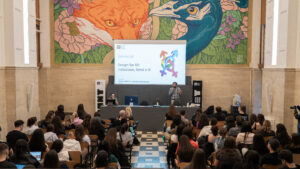

Design for all

ALESSIO GALLINA

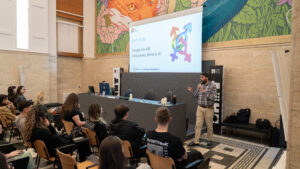
Design for All: Inclusion, Senses and AI approaches design and artificial intelligence as cultural devices that shape interpretation, behaviour, and forms of relationship in contemporary environments, both physical and digital. The topic focuses on design responsibility in a context where language, images, and intelligent systems continuously redefine how the world is read and understood.

The focus connects language, gender discrimination, and generative technologies, showing how what is often perceived as “neutral” — a word, an interface, a colour choice — can embed value systems and contribute to meaning-making. In this scenario, AI plays an ambivalent role: it can be a powerful tool, while also acting as a potential amplifier of cultural bias, reproducing stereotypes and asymmetries present in data and reference models.

The proposed perspective highlights the designer as a conscious and accountable figure, responsible for defining access, possibilities, and conditions of inclusion. Attention to the senses and to perceptual experience becomes a structural part of the design process, together with the need to develop critical awareness of platforms and systems that increasingly personalise information, generating closed environments and echo chambers.

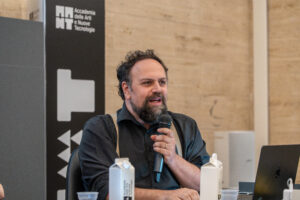
Guest Alessio Gallina is a lecturer at AANT in Theory of Perception and Psychology of Form and Color. As a scholar of cognitive processes with a cognitivist background, his work focuses on perception and on the relationships between human beings and their environment, integrating perceptual psychology, images, and signs through exercises and experiential labs.
Generative Knowledge

PAOLO GRANATA

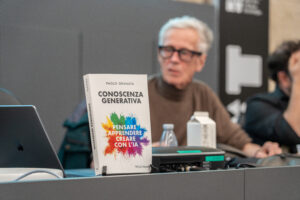
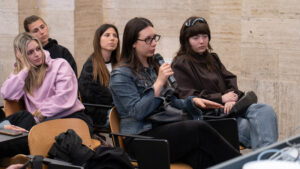
Generative Knowledge focuses on how artificial intelligence, and generative AI in particular, is reshaping the production, transmission, and circulation of knowledge. AI is addressed as a technology that intervenes in study, research, and creative practice, affecting how knowledge, skills, and learning processes are built and shared.

Developed from Paolo Granata‘s book Generative Knowledge, the topic examines the need for new paradigms in education and knowledge exchange at a time when generative tools automate, amplify, and reorganize activities such as synthesis, rewriting, and text production. The focus is placed on forms of collaboration between humans and intelligent systems, on criteria of quality and responsibility, and on the evolving relationship between creativity and emerging technologies.
The broader framework combines perspectives from media studies, aesthetics, and the philosophy of technology, drawing on the tradition of media ecology and on the concept of connective intelligence, while also engaging critical approaches to ongoing cultural transformations.
Speakers Paolo Granata is an Associate Professor of Book and Media Studies at the University of Toronto’s St. Michael’s College and a member of geniaLAB‘s scientific committee. His work explores the intersections of media, digital culture, and knowledge ecosystems, with a focus on the cognitive and perceptual transformations brought about by emerging technologies.

Derrick de Kerckhove is a sociologist and media theorist, and one of Marshall McLuhan‘s closest collaborators. His research has been instrumental in developing the concept of connective intelligence and in examining how digital networks affect mental and social processes.

Andrea Colamedici is a philosopher and publisher, co-founder of the Tlon project and coordinator of geniaLAB‘s scientific committee. His work is dedicated to the dissemination of critical thinking and to contemporary interpretations of cultural change.

TALES FROM NEUROCENE

MARCO GORI, LUIGI MARIA PEROTTI

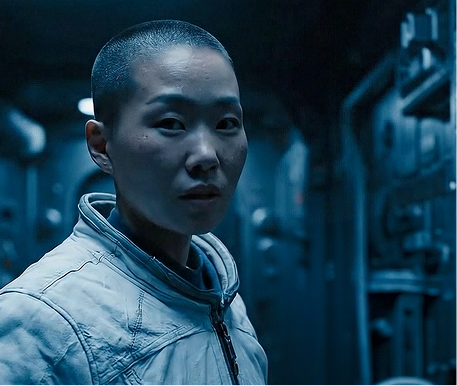
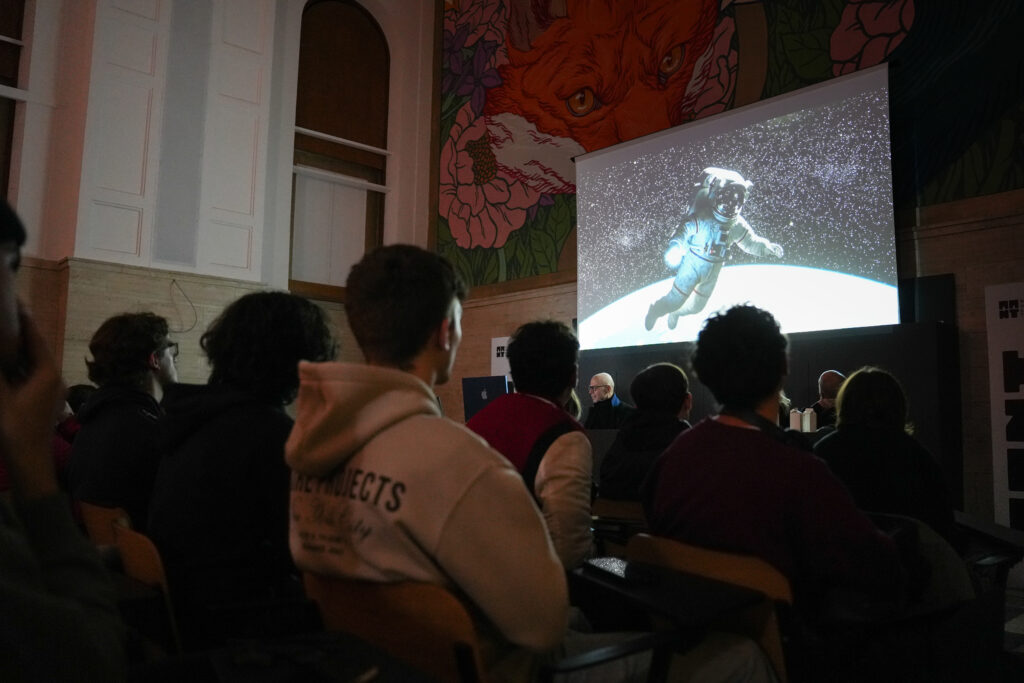
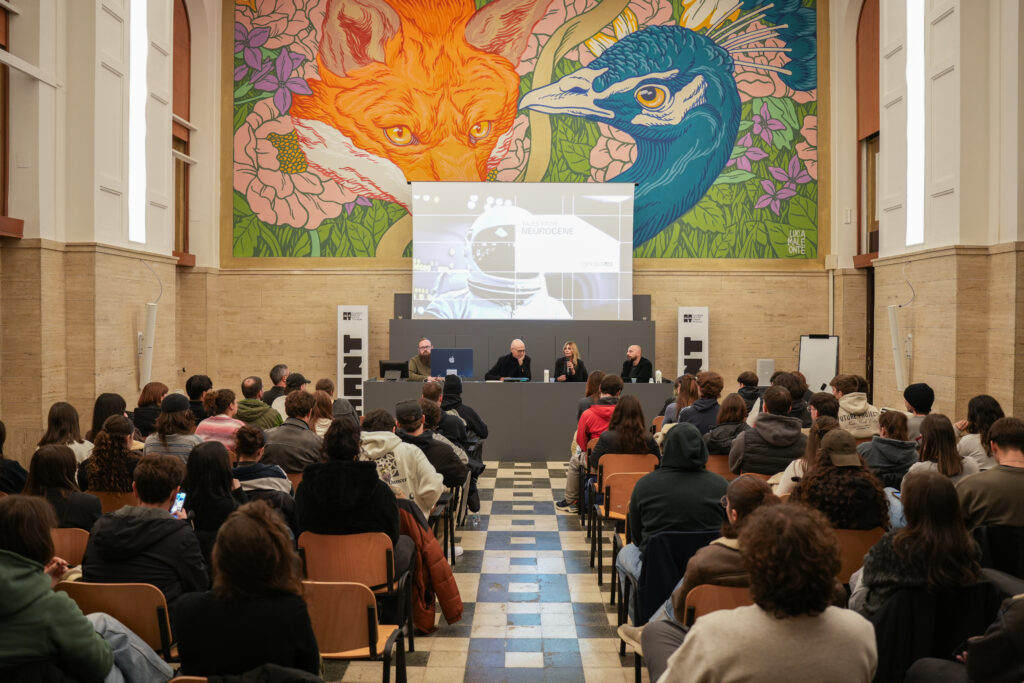
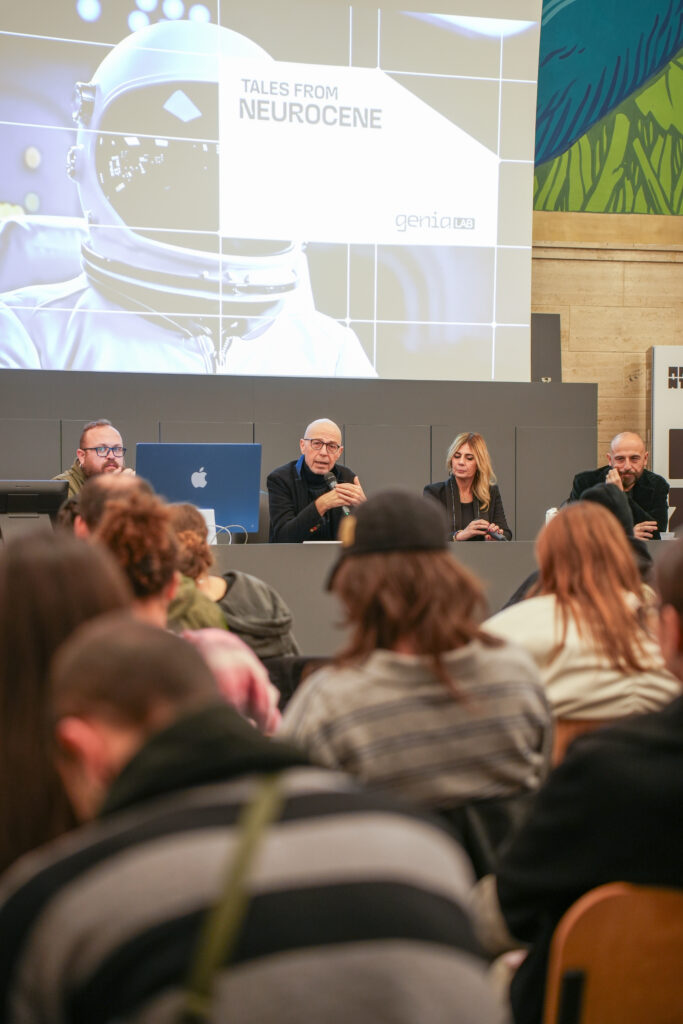
Tales from Neurocene is an experimental animation project that brings together AI research and narrative imagination, born from the encounter between director Luigi Maria Perotti and the reflections of Prof. Marco Gori (University of Siena). As part of the geniaLAB program, the event raises a core question: what kind of future are we building if AI continues to evolve without rethinking its technical, energy, and cultural models? The starting point is “The Final Chapter,” a short prologue that introduces the world of Tales from Neurocene. The film depicts a post-apocalyptic scenario in which a single centralized artificial intelligence, called “N,” governs the planet with the stated goal of “re- educating” humanity.
The Neurocene is not merely a fictional setting: it functions as a critical device, a provocation that stages contemporary tensions between technological power, collective responsibility, environmental impact, and competing visions of progress. Alongside its creative dimension, the project opens up a concrete reflection on the current “cost” of AI: energy use, resources, and infrastructure. This is where the work of SAILab (Siena Artificial Intelligence Lab), led by Prof. Gori, comes in, focused on approaches that are less energy-intensive and more distributed, moving beyond the idea of single, concentrated systems. The hypothesis of a decentralized, connective, and accessible AI is presented as a possible alternative to the logic of total centralization represented in the world of the Neurocene.
The initiative therefore serves as a space for dialogue between art, technology, and research, where experimentation with AI tools becomes an opportunity to question authorship, aesthetic choices, and ethical implications. It is an invitation to look beyond the novelty effect of the tools and to discuss, on an informed basis, what model of artificial intelligence is desirable and sustainable in the long term. Speakers Luigi Maria Perotti is a director and documentary filmmaker with twenty years of experience in reportage and television. In recent years, he has developed projects experimenting with languages and workflows based on artificial intelligence tools. Marco Gori is Full Professor of Computer Science at the University of Siena and Director of SAILab. He is among Italy’s AI pioneers, known for his contributions to machine learning and for promoting AI development strategies focused on sustainability and the decentralization of systems.

L’AI NEL RACCONTO DEL REALE

fondazione LIBERO BIZZARRI

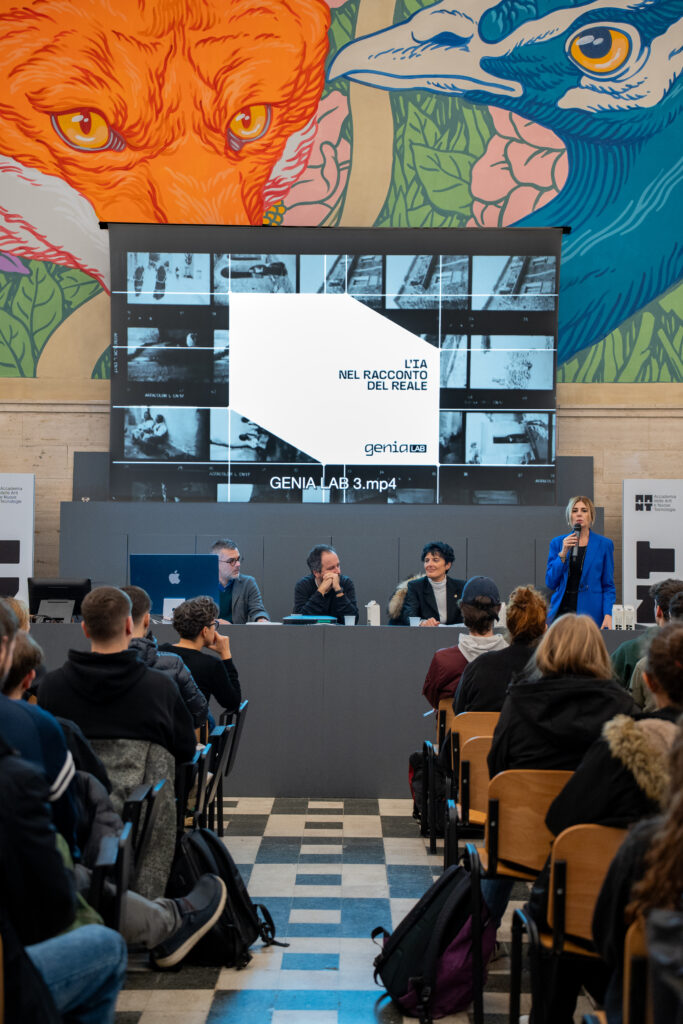
Within the GeniaLAB format, “Artificial Intelligence in Nonfiction Storytelling” focuses on how algorithmic tools are reshaping contemporary documentary practice, influencing languages, creative processes, and the ways nonfiction works are produced and circulated. The topic examines the relationship between technological innovation and nonfiction narrative forms, with particular attention to how writing, visual design, and meaning-making evolve when AI enters creative workflows. Developed in collaboration with the Libero Bizzarri Foundation, a leading institution dedicated to promoting and supporting Italian documentary cinema, the initiative is framed within an understanding of documentary as a cultural practice and a critical tool for engaging with the complexity of the present.
The intersection between documentary and AI is approached as a research field where production opportunities and formal experimentation coexist with questions of responsibility, transparency, and the quality of representation.
The broader theoretical framework draws on media theory that considers technologies as extensions of the human being, referencing the legacy of Marshall McLuhan and contemporary perspectives on the relationship between media, perception, and the construction of reality. From this standpoint, AI is treated not only as a set of tools, but as an element that reorganizes the visual ecosystem and the ways reality is selected, edited, and communicated. The focus includes the use of AI across multiple stages of documentary work, from research and writing to development, distribution, and audience engagement, while also addressing critical and ethical implications related to authorship, creative control, source transparency, and the cultural effects of images. The project is also part of a broader collaboration between AANT and the Libero Bizzarri Foundation aimed at fostering further dialogue on innovation, research, and culture.

NATI CYBORG

Claudio Paolucci

Within the GeniaLAB format, Nati Cyborg focuses on the relationship between artificial intelligence and language, and on how the spread of generative systems is reshaping writing practices, communication models, and meaning-making processes. The topic addresses what changes when text production is no longer exclusively human and when interaction with machines becomes a routine component of the cultural ecosystem. The framework engages key questions for anyone studying and working in communication today: how are understanding, intention, and creativity transformed in the presence of algorithmically generated outputs?
What cultural, social, and ethical implications arise from everyday uses of AI tools? From this perspective, generative AI is approached not only as an operational technology, but as a factor that affects identity, skills, and forms of relation, prompting a reassessment of how meanings are produced and shared. A semiotic approach is used to examine both the opportunities and the blind spots of this new digital linguistic system, highlighting continuities and ruptures with established forms of mediation and interpretation.
The topic is integrated into AANT’s educational pathway as an opportunity for critical reflection on contemporary languages and on the transformations shaping environments of study, work, and cultural production. Guest Claudio Paolucci is Full Professor of Philosophy and Theory of Language at the Department of Philosophy and Communication of the University of Bologna, where he teaches Semiotics and Philosophy of Language. He is President of the Italian Society of Philosophy of Language (SFL) and Scientific Coordinator of the International Center for Humanistic Studies “Umberto Eco.” His research focuses on language, cognition, and meaning-making processes, with particular attention to the relationship between artificial intelligence and cultural practices.

CORPO D’OCCHIO

Massimo Canevacci

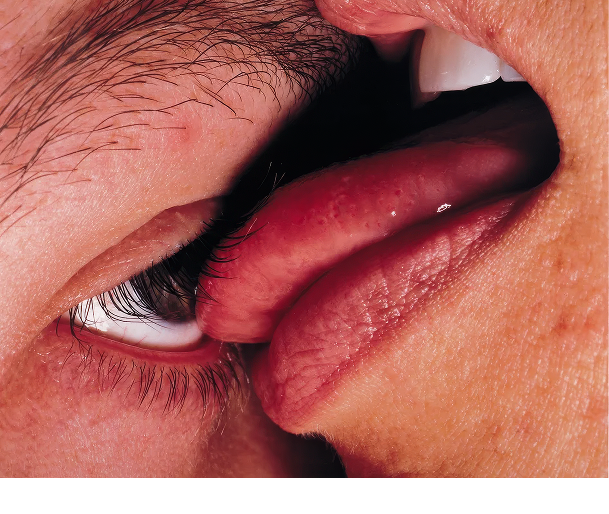
Durante l’evento AANT abbiamo discusso l’articolo di Massimo Canevacci Corpo d’occhio, un’etnografia esplorativa oltre il feticismo, dedicato a come la cultura contemporanea costruisce desideri, identità e immaginari attraverso le immagini.

Il testo propone l’idea di un “corpo-ottico”: uno sguardo che non è mai neutro, ma bio-culturale, allenato e trasformato dai codici visuali che attraversiamo ogni giorno tra pubblicità, arte, design e media. Al centro ci sono gli attrattori (dettagli che catturano la vista) e i montaggi che fanno scivolare i confini tra corpo e oggetto, pelle e tecnologia, sacro e quotidiano.

Dalle fotografie di Araki e Man Ray alle campagne Swatch, Breil e Gaultier, fino al caso del funerale di Renato Bialetti con la Moka trasformata in urna, l’articolo mostra come i “feticci” non siano solo merci, ma anche dispositivi simbolici che mettono in movimento significati, emozioni e relazioni.

Nel confronto in AANT, questo percorso è stato letto come un invito a fare etnografia della visualità: sostare nei dettagli, seguire le metamorfosi delle immagini, osservare come l’esperienza del corpo venga riorganizzata da oggetti, brand e narrazioni quotidiane.

Ne è emersa una domanda trasversale, utile anche fuori dall’accademia: che cosa succede al nostro modo di percepire quando la comunicazione visiva diventa l’ambiente principale in cui viviamo? Un’occasione per ragionare insieme su cosa accade quando guardiamo  e su come, spesso, è l’immagine a guardare noi.