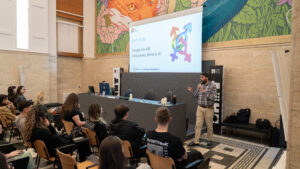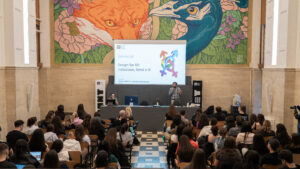

ALESSIO GALLINA
Design for All: Inclusion, Senses and AI approaches design and artificial intelligence as cultural devices that shape interpretation, behaviour, and forms of relationship in contemporary environments, both physical and digital. The topic focuses on design responsibility in a context where language, images, and intelligent systems continuously redefine how the world is read and understood.
The focus connects language, gender discrimination, and generative technologies, showing how what is often perceived as “neutral” — a word, an interface, a colour choice — can embed value systems and contribute to meaning-making. In this scenario, AI plays an ambivalent role: it can be a powerful tool, while also acting as a potential amplifier of cultural bias, reproducing stereotypes and asymmetries present in data and reference models.
The proposed perspective highlights the designer as a conscious and accountable figure, responsible for defining access, possibilities, and conditions of inclusion. Attention to the senses and to perceptual experience becomes a structural part of the design process, together with the need to develop critical awareness of platforms and systems that increasingly personalise information, generating closed environments and echo chambers.
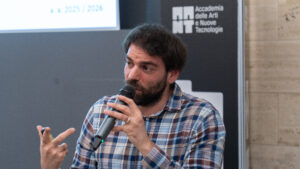
Guest Alessio Gallina is a lecturer at AANT in Theory of Perception and Psychology of Form and Color. As a scholar of cognitive processes with a cognitivist background, his work focuses on perception and on the relationships between human beings and their environment, integrating perceptual psychology, images, and signs through exercises and experiential labs.