
What does it mean to design today, in a context where language, images and intelligent technologies continuously reshape the way we interpret the world?
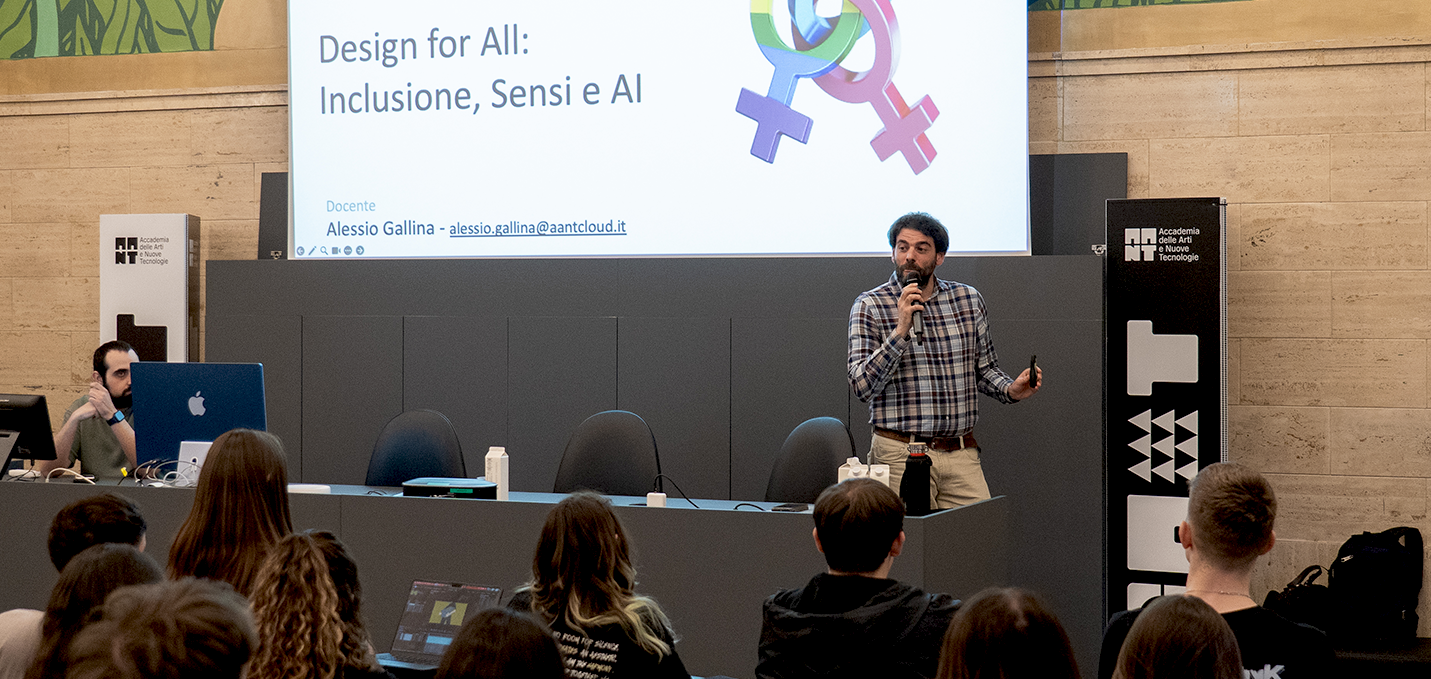
It is from this question—both simple and radical—that the latest GeniaLAB session, held on April 28 and titled “Design for All: Inclusion, Senses and AI,” took shape. The event transformed AANT’s main lecture hall into a critical laboratory, where design and artificial intelligence were explored not merely as tools, but as cultural devices. Guided by the talk of Alessio Gallina, students from the three-year academic programs engaged in a path that connected language, gender discrimination and AI systems, highlighting how what appears neutral—a color, an interface, a word—is in fact part of a broader system of meaning-making.
During the session, introduced and moderated by Prof. Gianna Angelini, Scientific Director and Head of Internationalization at the Academy, it became clear that discrimination is not only a visible social phenomenon, but also a structure embedded within symbolic systems: in languages, visual representations and the logics that shape contemporary technologies. In this context, artificial intelligence takes on an ambivalent role. On one hand, it is a powerful tool; on the other, it acts as an amplifier of cultural bias, capable of reproducing and reinforcing stereotypes through outputs that become actual discursive acts. Digital platforms, moreover, increasingly tend to build personalized environments, turning into closed spaces that reinforce pre-existing beliefs.
The key turning point proposed by the event concerns the role of the designer. No longer a mere executor of functional solutions, but a conscious figure, called to continuously question their own work. From this perspective, designing means taking responsibility: defining possibilities, creating access, and imagining forms of inclusion. The reflections that emerged during the session fit into a broader framework, where design is recognized as an intrinsically cultural practice, capable of influencing how people inhabit both physical and digital spaces, and how they build relationships.