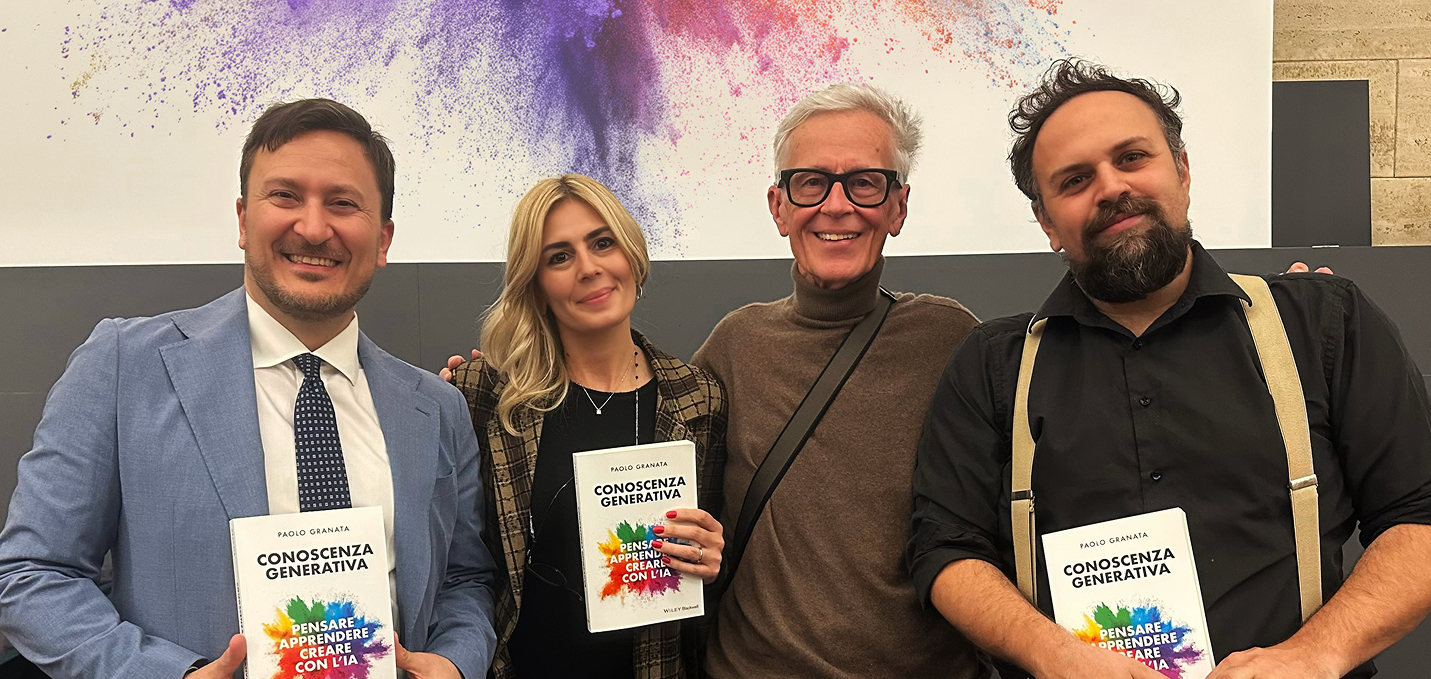
On Monday, April 13, AANT – Academy of Art and New Technologies hosted a new event in the geniaLAB series, a format dedicated to exploring contemporary languages and the cultural transformations driven by innovation.
At the core of the meeting was the presentation of Generative Knowledge by Paolo Granata, a volume that offers a critical and in-depth analysis of the ongoing changes in the processes of knowledge production and transmission that seeks to answer an increasingly urgent question: what does it mean to know, to learn, and to create in the age of AI?
Artificial intelligence, in fact, is not merely a technological tool, but is profoundly reshaping the ways in which knowledge is generated, shared, and applied.
The discussion, moderated by Professor Gianna Angelini, Scientific Director and Head of Internationalization at the Rome Academy, featured contributions from Derrick de Kerckhove and Andrea Colamedici, fostering a dialogue that intertwined theoretical, cultural, and philosophical perspectives. The event provided undergraduate students with valuable interpretative tools to better understand the relationship between creativity, technology, and knowledge.
About the speakers:
Paolo Granata, professor at the University of Toronto, is one of the leading scholars in the field of media studies, aesthetics, and digital culture. His research focuses on the cognitive and perceptual transformations brought about by emerging technologies.
Derrick de Kerckhove, sociologist and media theorist, was one of Marshall McLuhan’s closest collaborators. His work has been instrumental in defining the concept of connective intelligence, analyzing the impact of digital networks on mental and social processes.
Andrea Colamedici, philosopher and publisher, is co-founder of Tlon, a cultural project dedicated to the dissemination of critical thinking and the reinterpretation of philosophy in a contemporary context, with particular attention to ongoing cultural transformations.