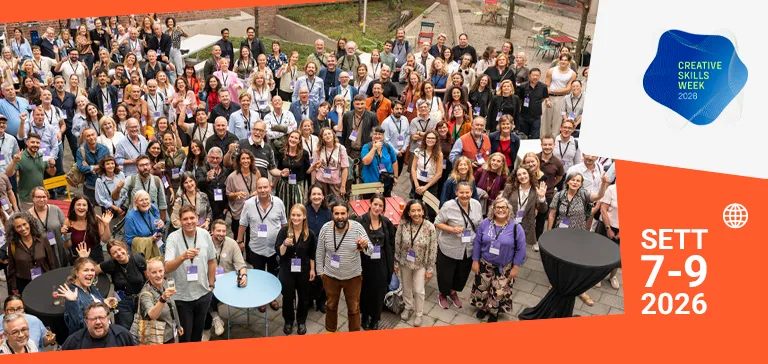
From 7 to 9 September, Brussels hosted the fourth and final edition of Creative Skills Week, an event dedicated to the future of creative skills in Europe and part of CYANOTYPES, a project funded by the European Union.
The event, attended by AANT lecturer Enrico Di Munno, took place at LUCA School of Arts and ICHEC Brussels Management School. It brought together public and private educational institutions from several European countries, providing an opportunity to reflect on the work carried out over the past four years and discuss the transformations currently reshaping education and the creative industries.
Three days of meetings, workshops and working sessions focused on Creative Skills, exploring their role within schools and training institutions against a backdrop of profound digital, technological and geopolitical change.
The first day, dedicated to “Why Creative Skills Matter”, opened the discussion on the value of creative skills through the CYANOTYPES Creative Agency Clinic. The session showcased a wide range of pilot projects developed by the institutions involved in the programme, including the experience of AANT and Genialab. The discussion highlighted how creativity, the ability to connect different disciplines, experimentation and adaptability are playing an increasingly important role in the development of new educational models.
The second day focused on “Making Creative Skills Systemic”, with workshops and opportunities for direct exchange between institutions around their respective pilot projects. The thematic working sessions brought to light strategies, challenges and perspectives related to the application of the CYANOTYPES framework as a tool for designing and evaluating educational programmes aimed at developing Creative Skills. In this context, AANT presented its experience with BIP Secret Spaces, a pilot project that has already been implemented and is now undergoing further development.
The third and final day, dedicated to “What Needs to Change”, brought together the reflections that emerged during the previous sessions, focusing on how Creative Skills can be strengthened as tools for designing and interpreting contemporary education.
Three main directions emerged from the discussion: strengthening the dialogue between creative, humanities and technological disciplines; developing shared methods for assessing skills, including transversal skills; and maintaining the international network established through CYANOTYPES, in order to continue sharing experiences and developing new educational models.