New GeniaLAB Event: Artificial Intelligence, Storytelling of Reality, and New Horizons for Documentary

Artificial intelligence is profoundly transforming the way reality is observed, interpreted, and narrated, redefining languages, creative processes, and modes of production within contemporary documentary filmmaking. These themes were at the core of “GeniaLAB – Artificial Intelligence in the Storytelling of Reality”, the final GeniaLAB event of 2025, held on Tuesday, December 17 at AANT – Academy of Arts and New Technologies, in collaboration with the Libero Bizzarri Foundation and moderated by Prof. Gianna Angelini.

The event opened with a brief introduction to the history of the Libero Bizzarri Foundation, a leading institution dedicated to the promotion and enhancement of Italian documentary cinema. Over the years, the Foundation has supported the growth of numerous authors and filmmakers, fostering a vision of documentary as a critical and cultural tool capable of interpreting the complexity of reality and questioning the present.

In her contribution, Prof. Gianna Angelini outlined the conceptual framework of the evening, linking it to the dialogue with Prof. Derrick de Kerckhove and to the thought of Marshall McLuhan, a central figure in media theory who explored technologies as extensions of human perception and cognition. This theoretical reflection was followed by the screening of a four-minute excerpt from Libero Bizzarri’s documentary on Marshall McLuhan, offering students enrolled in AANT’s undergraduate programmes a visual and conceptual stimulus to further explore the relationship between media, technology, and the perception of reality.

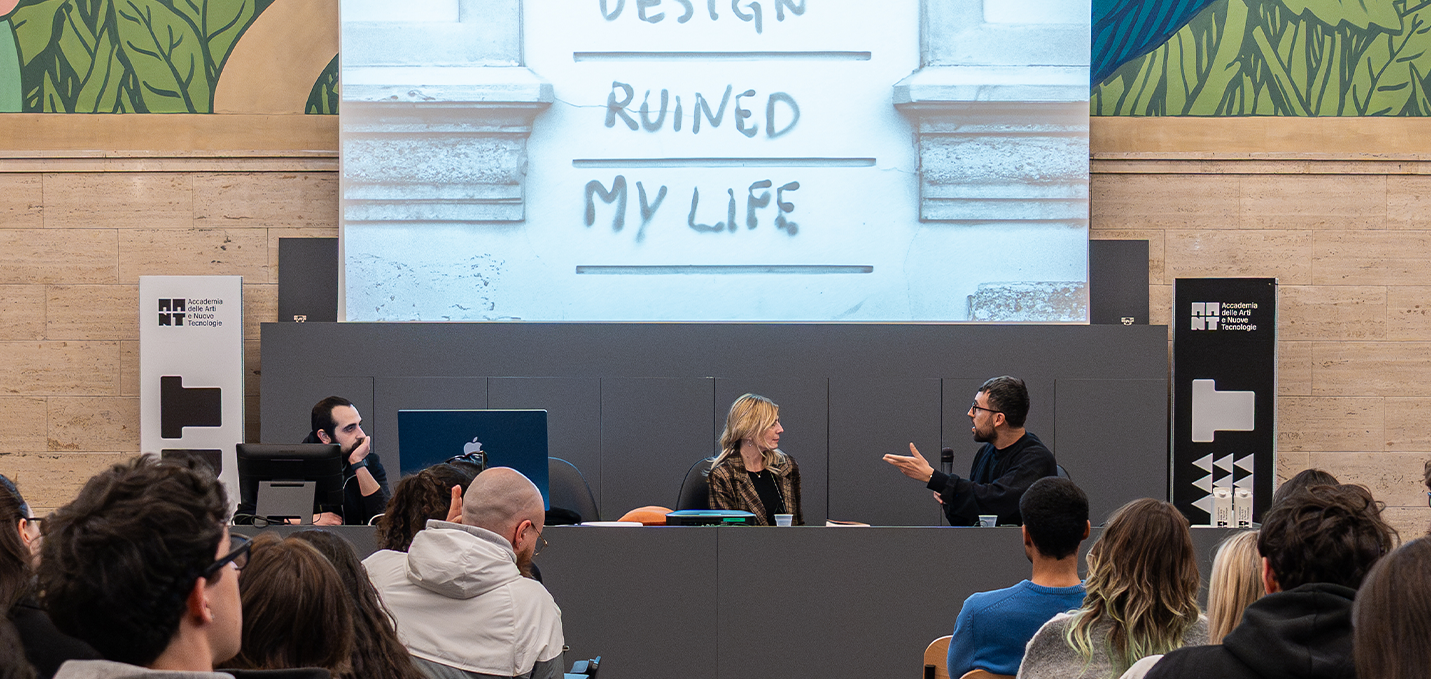
The core of the event was dedicated to the contribution of guest speaker Giacomo Cannelli, in dialogue with Prof. Valerio Di Paola, accompanied by the screening of selected reels and video materials. The discussion explored the potential of artificial intelligence across the different stages of documentary practice—from research and writing to staging and audience engagement. Alongside the narrative and productive opportunities offered by algorithmic tools, the conversation also addressed the ethical and critical implications of AI, questioning the role of the author, creative responsibility, and the relationship between human intelligence and intelligent systems in shaping new visual imaginaries.

The event marked the beginning of a collaboration between AANT and the Libero Bizzarri Foundation, which in the coming months will bring new guests to the Academy in Rome, fostering dialogue with students on innovation, research, and contemporary culture.

Guest note: Giacomo Cannelli is an author and screenwriter with extensive experience in audiovisual production for television and digital platforms. An AI Senior Artist, he focuses on artificial intelligence applied to narrative and visual languages, exploring the relationship between creativity, technology, and new imaginaries.

AI Meets the SDGs. AI and the 2030 Agenda at the heart of the Stuttgart BIP

A group of AANT students, together with Professor Davide Cardea, recently traveled to Stuttgart to take part in the BIP (Blended Intensive Programme) “AI Meets the SDGs.” This event represented an important opportunity for internationalization and experimental learning. In addition to students from the Academy’s three-year programs in Rome, it also involved participants from Stuttgart Media University in Stuttgart, Howest University of Applied Sciences (Hogeschool West-Vlaanderen) in Kortrijk, the Amsterdam University of Applied Sciences (Hogeschool van Amsterdam) in Amsterdam, and Chulalongkorn University in Bangkok.

The program focused on creative design applied to the Sustainable Development Goals (SDGs) of the 2030 Agenda, through multidisciplinary working groups made up of students with backgrounds in design, advertising, videomaking, programming, and marketing. The exchange among different skills and cultures fostered the development of projects capable of addressing real-world problems from multiple perspectives.

Within the BIP, particular attention was devoted to artificial intelligence as a tool to support the creative process, along with a critical reflection on the role of AI in contemporary design. For the students, the experience provided a concrete opportunity for growth and international exchange, confirming AANT’s commitment to an educational approach that integrates creativity, technological innovation, and social responsibility.

Below is the list of participating students:
Fiore Sofia
Lanotte Martina
Nobiloni Giulia
Onofri Marco Sabino
Pagliano Gioia
Porfirio Luca
Portacci Paola Rita
Pugliese Gaia
Sambucci Elena
Tosti Maria

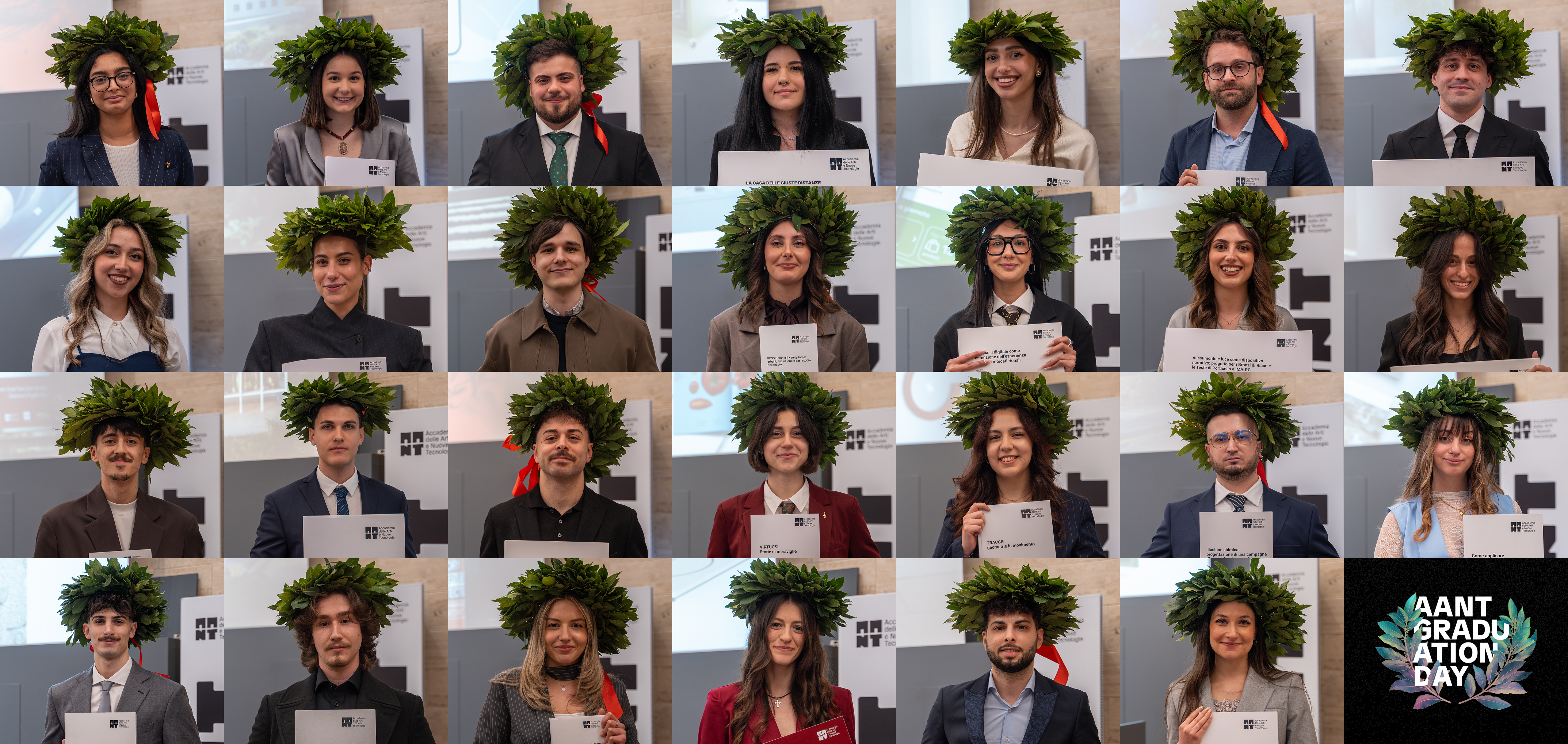
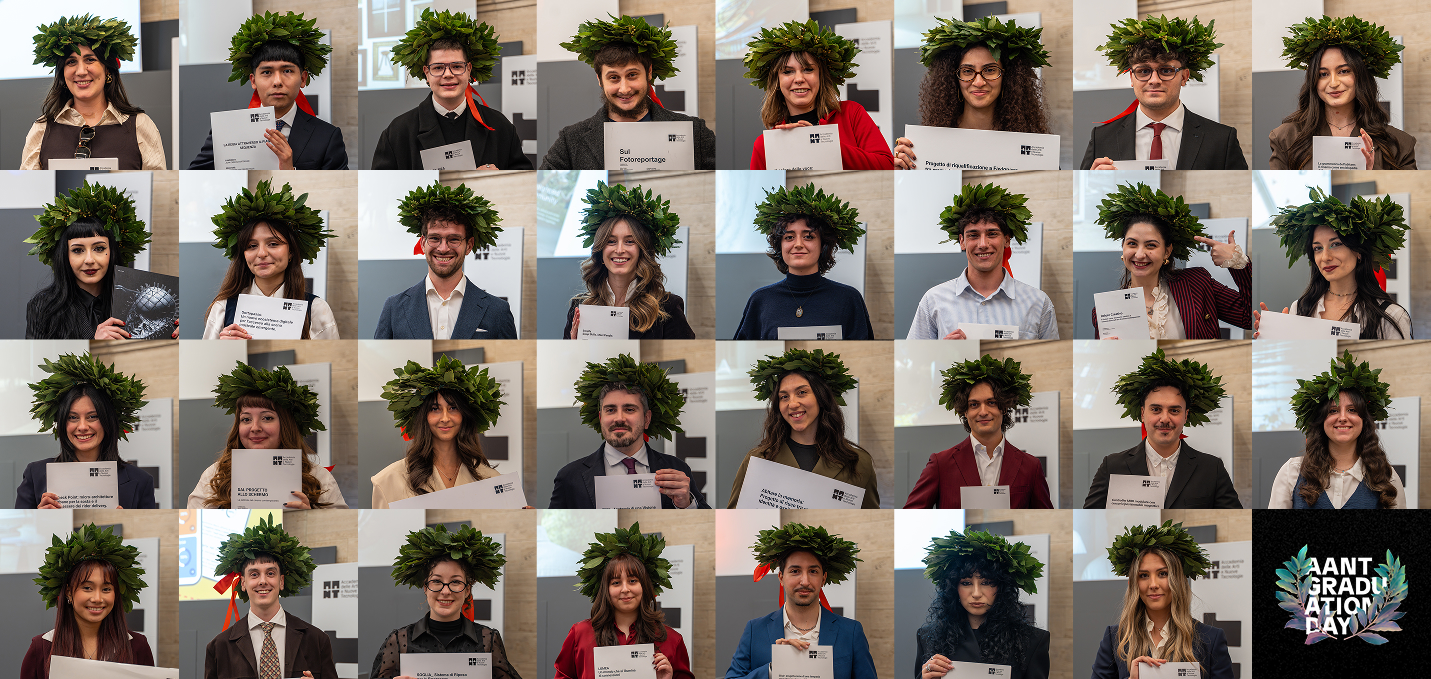
Creativity, Research and Vision: 14 New AANT Graduates Present Their Thesis Projects

On December 13, AANT – Academy of Arts and New Technologies held a new graduation session in Rome, celebrating 14 graduates from its undergraduate (three-year) programs. The event marked an important academic milestone, highlighting the results of an educational path strongly focused on research, experimentation and interdisciplinary practice.

The graduates and their thesis projects are as follows:

Antonio Ciampa: “Ristrutturazione e Riqualificazione di un edificio storico a Fontaneto d’Agogna”;

Alessandra Brundu: “Esperienza multisensoriale immersiva nella Tuscia”; 

Dylan Leoni: “L’Espressionismo, la Fotografia, il Cinema: la rappresentazione emotiva e psicologica nel Novecento”; 

Brunella Iorio: “Step up Comedy”;

Carola Improta: “Masseria Gaggiano: Progetto di riqualificazione e riuso di una masseria in Puglia”;

Claudia Gulizia: “Casa Bongiorno a Stromboli: allestimento per la memoria e la conservazione”;

Maria Michela Salcuni: “Radici e futuro: come lo smart working può favorire il ritorno al Sud”;

Nita Tudor Dorin: “CON – La rinascita del collettivo”;

Lorenzo Lang: “L’evoluzione del design pubblicitario dalla stampa grafica all’utilizzo dei social media”;

Giovanni Conigliaro: “Serpenti Infinito Exhibition – India”;

Luca De Francesco: “FOMO L’ansia di restare indietro nell’era iperconnessa”;

Thiam Seynabu: “Zoo della cura: strategie di design e narrazione per umanizzare l’esperienza clinica del bambino”;

Valeria Giardina: “Tracce di libertà”; 

Andrea Piccardi: “Design Everything Nation: Manifesto del creativo”.

We wish all graduates a professional future filled with success and new opportunities!

Presented at AANT: the Tales from Neurocene project

On Wednesday, 3 December 2025, the Aula Magna of AANT in Rome hosted the presentation of Tales from Neurocene, an innovative experimental animated film project conceived by director Luigi Maria Perotti and inspired by the theories of Prof. Marco Gori of the University of Siena.
The event, organized as part of the activities of the new research HUB geniaLAB dedicated to artificial intelligence, was moderated by Prof. Gianna Angelini, scientific director and head of internationalization at AANT.
At the heart of the meeting was the screening of “The Final Chapter”, a short film of about 10 minutes that serves as a prologue to the narrative universe of Tales from Neurocene. This brief film – a teaser created entirely with artificial intelligence tools – immerses the viewer in a futuristic, post-apocalyptic world governed by a centralized AI called “N”, tasked with re-educating humanity so that it “does not repeat the same mistakes” made in the past.
The idea of the Neurocene – the name given to this scenario – stems from the desire to imagine what might happen if, in the coming years, we fail to find a different approach to the potential of AI. The short film presented at AANT is therefore a creative provocation intended to prompt reflection on the future of artificial intelligence and on the ethical and environmental implications of its development.
During the presentation, Perotti and Gori explained how Tales from Neurocene was born from a meeting at the University of Siena, where Prof. Gori and his team (SAILab) are working on an approach to AI that is less energy-intensive and more decentralized than current models. In particular, they highlighted the problem of the high resource consumption of today’s AI systems: each individual query to an AI model can require the same amount of energy as charging a smartphone, and it is estimated that within five years the energy and water consumption of AI could match that of a country like Japan. These figures aroused considerable interest among students, opening a debate on the urgent need to rethink intelligent technologies in a sustainable way.

From Mimesis to Machine:
AANT at the Swiss Institute’s AI conference

Today, Thursday 27 November, the conference “From Mimesis to Machine: AI and the Evolution of Artistic Creation” is being held at the Swiss Institute in Rome, as part of the Innovation series and in collaboration with HEAD – Genève.

The event, held entirely in English, brings together designers, historians and educators for a day of talks and workshops, with the aim of exploring how artificial intelligence is redefining our relationship with images, tradition and knowledge. It also reflects on how academic art education is responding to these changes in a critical and creative way.

Representing AANT is the Scientific Director and Head of Internationalization, Prof. Gianna Angelini, who will speak about the Academy and describe how AI is now deeply integrated into AANT’s teaching across all study programs (Three-year Bachelor’s Degrees, Specialist Two-year Programs and Master’s) at AANT in Rome, during the panel: “Teaching Creativity in the Age of Algorithms.”

Game and Virtual Design: AANT Launches the New Academic Year’s Mobility Programme

From 24 to 28 November 2025, AANT’s Game and Virtual Design coordinators, Simone Mari and Ennio Pirolo, will be in Stuttgart to take part in the International Week at Hochschule der Medien, officially inaugurating the mobility activities of the new academic year.
The collaboration between AANT and the German university is now well established and, in addition to the usual short-term mobility opportunities for students and staff, this year also introduces long-term mobility options specifically dedicated to students.

The working week includes seminars, workshops, and interactive activities designed to provide participants with tools and strategies to develop innovative international collaborations. The programme will address several key topics, including:

  • promoting resilience to better recognise and manage stress related to university life; 
  • exploring the world of videogames from technical, creative, and cultural perspectives, through lectures held by experts from the gaming sector; 
  • presentations by HdM partner universities illustrating international study opportunities available to interested students. 

Internationalisation is a crucial element of AANT’s educational and research activities. The International Relations Office, led by the Head Prof. Gianna Angelini, supports and develops partnerships with foreign universities, promoting student and staff mobility and fostering genuine intercultural learning.

OPEN AANT: Domitilla Dardi presents
EDIT Napoli

On Tuesday, 18 November, AANT hosted a presentation of EDIT Napoli, led by Domitilla Dardi. Students from the bachelor’s programmes had the opportunity to learn about the origins of this important editorial design fair, founded in June 2019.

Now in its 7th edition, EDIT Napoli was created to fill a gap in the landscape of design fairs. On one side are independent designers who are too small to take part in large international events such as the Salone del Mobile; on the other, companies that produce high-quality objects but struggle to establish a dialogue with buyers, designers, and industry professionals.
Dardi’s project addresses this very need: to create a platform capable of connecting niche creative realities with architects, interior designers, retailers, and sector operators, while promoting an authentic, responsible, and research-driven approach to design.

About the guest: Domitilla Dardi is a design historian and curator. Since 2010 she has been the design curator at MAXXI – the National Museum of 21st-Century Arts in Rome, and in 2022 she was appointed Senior Curator. She has been a visiting professor at several Italian and international universities, collaborates with specialized magazines, and is the author of numerous monographs and essays on design culture.

AANT at the Salone dello Studente 2025:
where passion meets future skills

Once again this year, AANT took part in the Salone dello Studente at the Fiera di Roma, bringing its new creative concept:
“Love is the only thing that matters. Yes, but you need skills.”

At the fair, we wanted to express this message not only through words, but also through:

  • dedicated materials designed by our creatives
  • customized gadgets and bags, conceived as small storytelling objects
  • visuals and setups that transformed our stand into a narrative space

At the Salone dello Studente, we met hundreds of young people eager to discover their talent. Thanks to the contributions of our tutors and students, we were able to share with them the spirit and energy of our creative community.

Libero Bizzarri Award: creative intelligence and new forms of storytelling

From 13 to 16 November, the 32nd edition of the Libero Bizzarri Award was held at the Museo del Mare Hall in San Benedetto del Tronto. This year, the central theme of the event—organized by the Libero Bizzarri Foundation in collaboration with the Marche Region and the Directorate-General for Cinema and Audiovisual of the MIC—was creative intelligence and new forms of storytelling. Through debates, talks, and screenings, the festival explored a highly topical thread: the role and influence of artificial intelligence in the world of cinema.

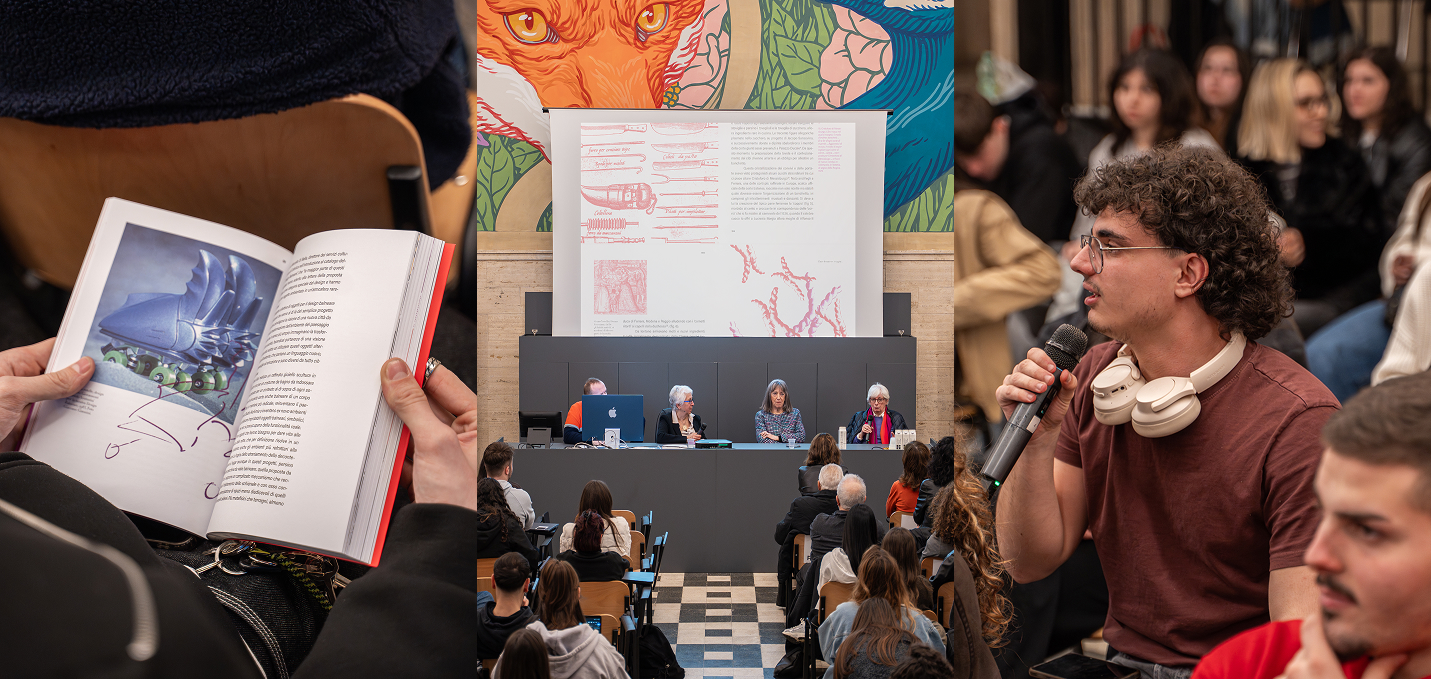
Among the scheduled events, one was particularly significant for AANT. On Friday the 14th, at the Academy’s headquarters in Rome, sociologist Derrick De Kerckhove—member of AANT’s Scientific Committee and its geniaLAB HUB—and Gianna Angelini, Scientific Director and Head of Internationalization at the Academy in Rome, took the stage. The meeting, titled “Connective Intelligence: the Impact of Media on Humans and Society,” also included the screening of the episode “McLuhan’s Electronic Village”, which examines the thinking of the renowned scholar through technological applications used in the fields of mass media and telecommunications.

The screening of Libero Bizzarri’s documentary provided the catalyst for an intense and multifaceted dialogue between Gianna Angelini and Derrick De Kerckhove. Prof. Angelini recalled how McLuhan redefined the categories through which we interpret modern communication, paving the way for a new sensitivity toward the media environment. Yet it fell to the next generation—De Kerckhove’s—to confront the emergence of the digital revolution, a territory McLuhan had only glimpsed and theorized.

During the conversation, Angelini described De Kerckhove as McLuhan’s “methodological and intellectual heir,” a scholar capable of expanding insights that are now more relevant than ever in the age of artificial intelligence and algorithmic pervasiveness. Revisiting McLuhan’s famous dictum “the medium is the message,” De Kerckhove underlined how it is not content that transforms us, but the medium itself—which reshapes perception, social bonds, and cognitive structures. From this premise arises his research on neuroculture, the discipline that investigates cognitive changes generated by new media environments.

The screening of Bizzarri’s documentary also brought back the voice and face of a strikingly contemporary McLuhan, capable of foreseeing the trajectory of technological transformations decades in advance. The recovered images, shown once again to the public, confirmed how essential his thought remains today for understanding not only the media but the very structure of contemporary experience.

The festival concluded on Sunday with the awards ceremony for the ITALIADOC and Opera Prima competitions—the latter dedicated to filmmakers under 35—along with the Andrea Pazienza Award for inventive use of images and graphics, the Libero Bizzarri Award for Best Documentary, and the Under 35 Audience Award.

I’ll Tell You How I Did It:
Sit Around Podcast

On Tuesday, November 11, AANT’s Aula Magna hosted Manuel Montefuscoli and Michela Cipolla, creators of Sit Around Podcast, as part of the event series titled “I’ll Tell You How I Did It.”. The meeting was moderated by Prof. Valerio Di Paola, coordinator of the Bachelor’s program in Videomaking.

The guests were able to present their podcast dedicated to creativity to the students — a project born as a radio space for dialogue and inspiration, featuring the voices of those who have managed to turn their talent into a lifelong profession. The format focuses on the connections between art, communication, and design, telling the stories and insights behind creative careers. The podcast is set to launch in February 2026, with each episode lasting between 50 and 60 minutes, inspired by the style of classic American talk shows — as if it were an informal chat among friends. Among the guests who have so far confirmed their participation in the project are: director Valerio Desiro, storyteller Il Signor Franz, pop duo Younuts!, Roman performer Er Pinto, entrepreneur Lorenzo Del Bianco, illustrator Luca Maleonte (who also created the mural in the Aula Magna), and content creator Simone Rosini. During the meeting with AANT students, Montefuscoli and Cipolla also announced that anyone interested in taking part in the organization and writing of the podcast episodes will be able to join the Farm, which will be held at the Academy in the coming months.

About the authors:

Manuel Montefuscoli is a Creative Director in advertising who, since 2009, has worked with SMEs and various multinational companies, applying creativity to corporate communication and growth.

Michela Cipolla holds a degree in Visual Arts, Communication, and Art Education. She works in cultural dissemination, aiming to bring the general public closer to a world often considered niche.