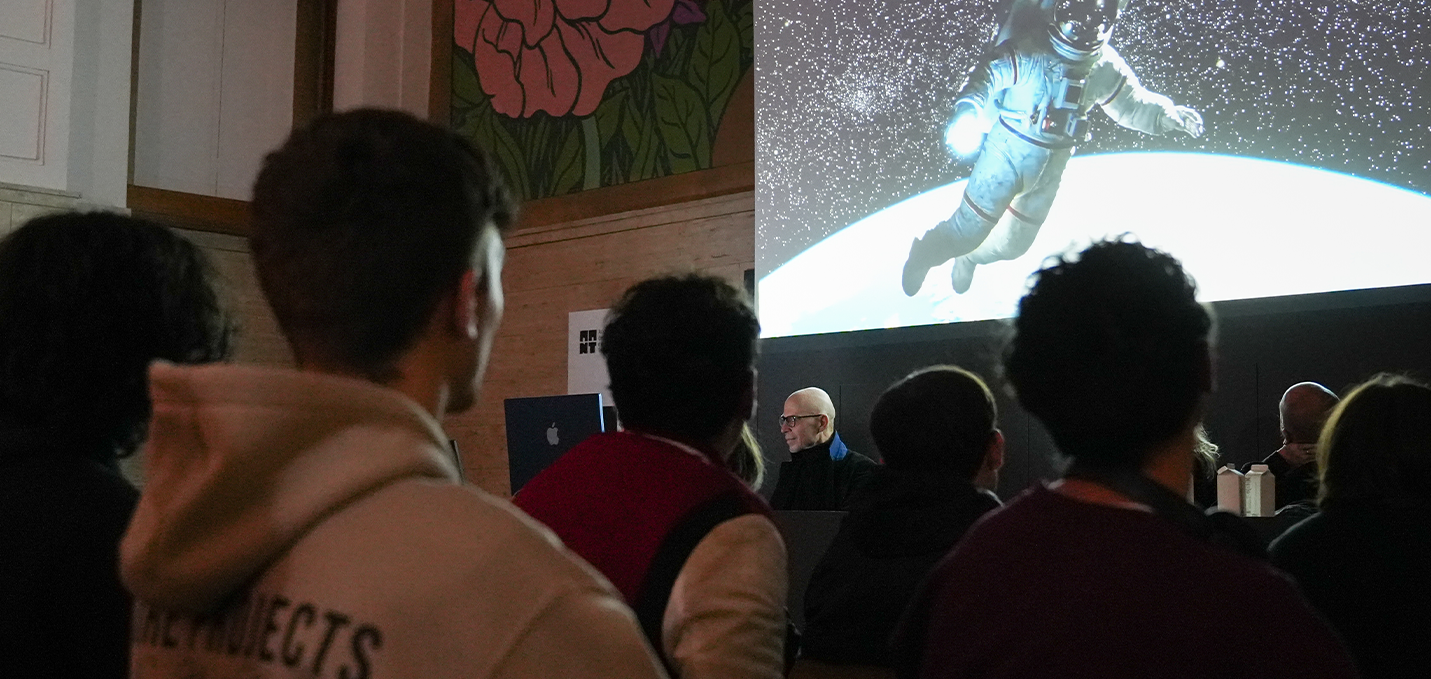
On Wednesday, 3 December 2025, the Aula Magna of AANT in Rome hosted the presentation of Tales from Neurocene, an innovative experimental animated film project conceived by director Luigi Maria Perotti and inspired by the theories of Prof. Marco Gori of the University of Siena.
The event, organized as part of the activities of the new research HUB geniaLAB dedicated to artificial intelligence, was moderated by Prof. Gianna Angelini, scientific director and head of internationalization at AANT.
At the heart of the meeting was the screening of “The Final Chapter”, a short film of about 10 minutes that serves as a prologue to the narrative universe of Tales from Neurocene. This brief film – a teaser created entirely with artificial intelligence tools – immerses the viewer in a futuristic, post-apocalyptic world governed by a centralized AI called “N”, tasked with re-educating humanity so that it “does not repeat the same mistakes” made in the past.
The idea of the Neurocene – the name given to this scenario – stems from the desire to imagine what might happen if, in the coming years, we fail to find a different approach to the potential of AI. The short film presented at AANT is therefore a creative provocation intended to prompt reflection on the future of artificial intelligence and on the ethical and environmental implications of its development.
During the presentation, Perotti and Gori explained how Tales from Neurocene was born from a meeting at the University of Siena, where Prof. Gori and his team (SAILab) are working on an approach to AI that is less energy-intensive and more decentralized than current models. In particular, they highlighted the problem of the high resource consumption of today’s AI systems: each individual query to an AI model can require the same amount of energy as charging a smartphone, and it is estimated that within five years the energy and water consumption of AI could match that of a country like Japan. These figures aroused considerable interest among students, opening a debate on the urgent need to rethink intelligent technologies in a sustainable way.
Presented at AANT: the Tales from Neurocene project