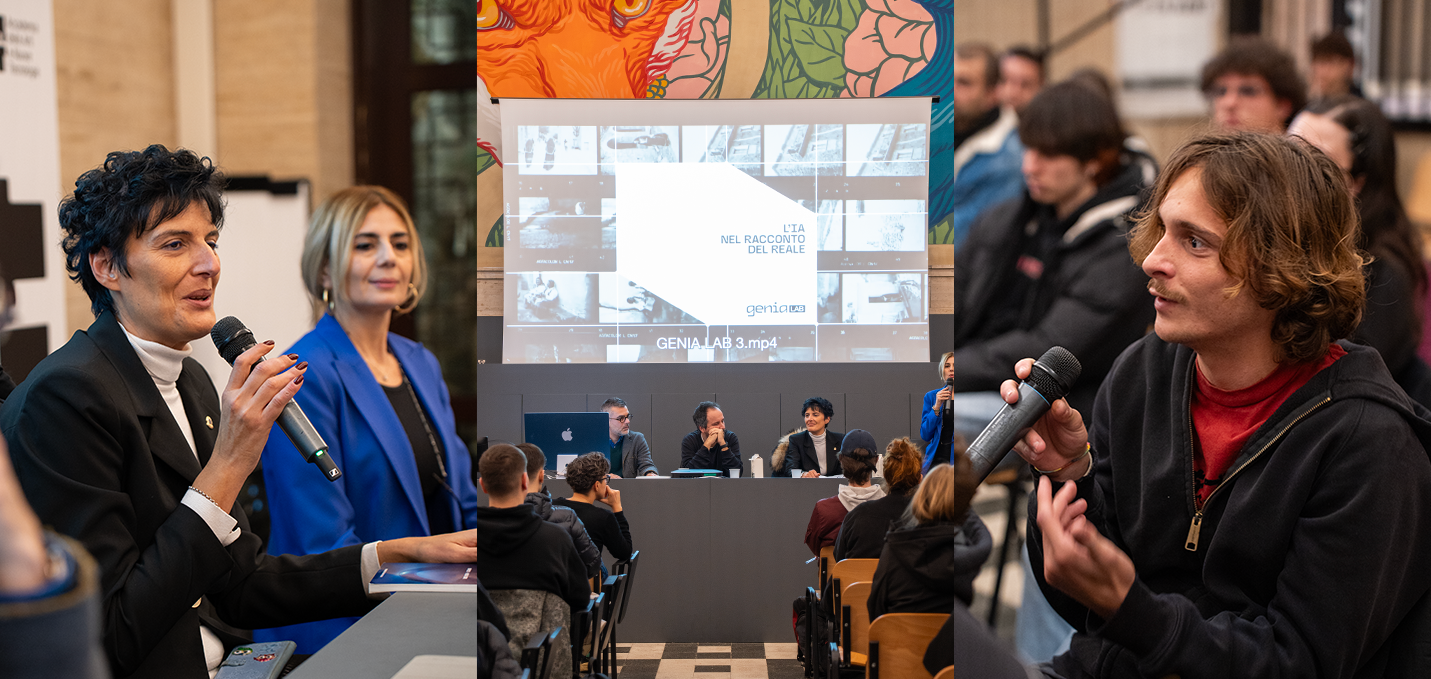
Artificial intelligence is profoundly transforming the way reality is observed, interpreted, and narrated, redefining languages, creative processes, and modes of production within contemporary documentary filmmaking. These themes were at the core of “GeniaLAB – Artificial Intelligence in the Storytelling of Reality”, the final GeniaLAB event of 2025, held on Tuesday, December 17 at AANT – Academy of Arts and New Technologies, in collaboration with the Libero Bizzarri Foundation and moderated by Prof. Gianna Angelini.
The event opened with a brief introduction to the history of the Libero Bizzarri Foundation, a leading institution dedicated to the promotion and enhancement of Italian documentary cinema. Over the years, the Foundation has supported the growth of numerous authors and filmmakers, fostering a vision of documentary as a critical and cultural tool capable of interpreting the complexity of reality and questioning the present.
In her contribution, Prof. Gianna Angelini outlined the conceptual framework of the evening, linking it to the dialogue with Prof. Derrick de Kerckhove and to the thought of Marshall McLuhan, a central figure in media theory who explored technologies as extensions of human perception and cognition. This theoretical reflection was followed by the screening of a four-minute excerpt from Libero Bizzarri’s documentary on Marshall McLuhan, offering students enrolled in AANT’s undergraduate programmes a visual and conceptual stimulus to further explore the relationship between media, technology, and the perception of reality.
The core of the event was dedicated to the contribution of guest speaker Giacomo Cannelli, in dialogue with Prof. Valerio Di Paola, accompanied by the screening of selected reels and video materials. The discussion explored the potential of artificial intelligence across the different stages of documentary practice—from research and writing to staging and audience engagement. Alongside the narrative and productive opportunities offered by algorithmic tools, the conversation also addressed the ethical and critical implications of AI, questioning the role of the author, creative responsibility, and the relationship between human intelligence and intelligent systems in shaping new visual imaginaries.
The event marked the beginning of a collaboration between AANT and the Libero Bizzarri Foundation, which in the coming months will bring new guests to the Academy in Rome, fostering dialogue with students on innovation, research, and contemporary culture.
Guest note: Giacomo Cannelli is an author and screenwriter with extensive experience in audiovisual production for television and digital platforms. An AI Senior Artist, he focuses on artificial intelligence applied to narrative and visual languages, exploring the relationship between creativity, technology, and new imaginaries.