
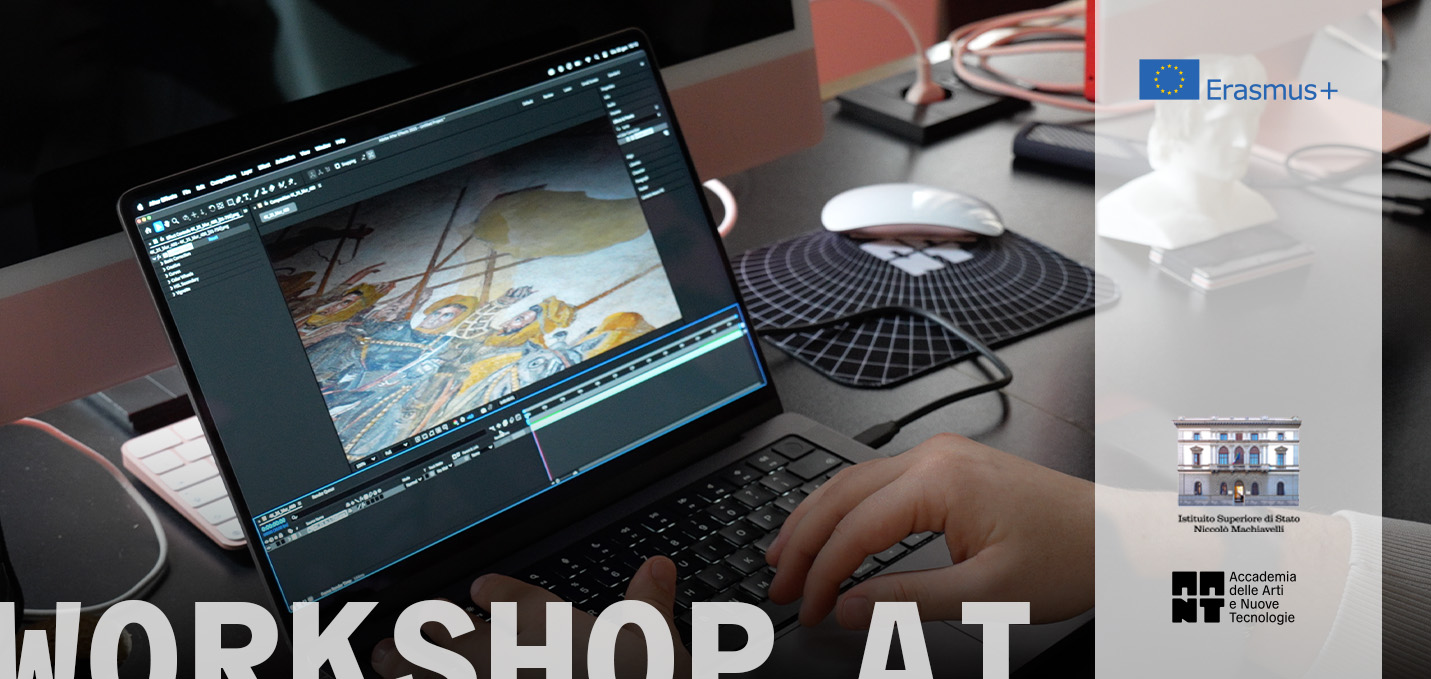
On Thursday, February 12, AANT hosted the workshop “Faces Reconstructed: Generative AI, Identity and Human Rights”, as part of the Erasmus+ Dissemination Week promoted by Liceo Machiavelli in Rome. The initiative, included in the international week entitled “Portraits, Self-Portraits and Inscriptions: The Faces of Identity and Human Rights Across Time,” brought together an international group of 20 Erasmus+ students, 10 Italian, 5 German and 5 Swedish, accompanied by 4 international teachers, with a shared objective: to explore the role of the face, image and self-representation across historical eras and within emerging technologies.
Led in English by Professor Davide Cardea, the workshop offered a solid educational and hands-on experience focused on highly relevant topics: identity, power, human rights and visual representation in the digital age. The session combined historical reflection with practical experimentation, starting from AANT’s creative project “Frammenti”, developed to merge historical research, contemporary art and digital technologies, and culminating in the documentary “Il volto di Alessandro” (“The Face of Alexander”), broadcast on Italian national television (RAI). Students had the opportunity to directly engage with the customized GPT tool “Finding AM,” which was used to investigate the historically attributed features of Alexander the Great’s face, examine sources, clarify ambiguities and experiment firsthand with AI-assisted interpretative image processes.
The second part of the workshop focused on a product-driven approach: each participant translated their reflections into visual and conceptual outputs, working on reconstruction models, interpretative hypotheses and practical generative AI tools. This methodology made the experience not only theoretical, but tangibly creative and productive.
The day concluded with a collective presentation session, during which students shared and discussed their work, reflecting on their choices, limitations and the potential of the technologies used. The final discussion highlighted crucial issues, including the subtle boundary between historical reconstruction and deepfake, and more broadly the ethical responsibility connected to the use of artificial intelligence in representing the human face — a symbol of identity, memory and rights.