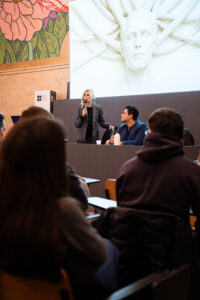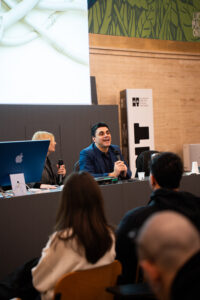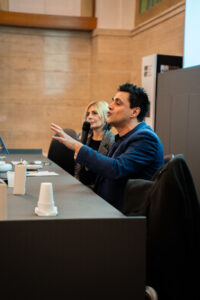
Claudio Paolucci
Within the GeniaLAB format, Nati Cyborg focuses on the relationship between artificial intelligence and language, and on how the spread of generative systems is reshaping writing practices, communication models, and meaning-making processes. The topic addresses what changes when text production is no longer exclusively human and when interaction with machines becomes a routine component of the cultural ecosystem. The framework engages key questions for anyone studying and working in communication today: how are understanding, intention, and creativity transformed in the presence of algorithmically generated outputs?
What cultural, social, and ethical implications arise from everyday uses of AI tools? From this perspective, generative AI is approached not only as an operational technology, but as a factor that affects identity, skills, and forms of relation, prompting a reassessment of how meanings are produced and shared. A semiotic approach is used to examine both the opportunities and the blind spots of this new digital linguistic system, highlighting continuities and ruptures with established forms of mediation and interpretation.
The topic is integrated into AANT’s educational pathway as an opportunity for critical reflection on contemporary languages and on the transformations shaping environments of study, work, and cultural production. Guest Claudio Paolucci is Full Professor of Philosophy and Theory of Language at the Department of Philosophy and Communication of the University of Bologna, where he teaches Semiotics and Philosophy of Language. He is President of the Italian Society of Philosophy of Language (SFL) and Scientific Coordinator of the International Center for Humanistic Studies “Umberto Eco.” His research focuses on language, cognition, and meaning-making processes, with particular attention to the relationship between artificial intelligence and cultural practices.